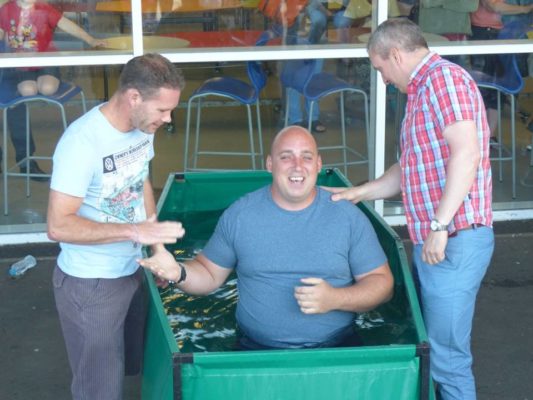
Portable Baptism Pool Solutions for Churches
We come from a church tradition that baptises believers by full immersion. The word “baptise” is transliterated from the Greek word baptizo — to dip, drench, or immerse so that a change of identity occurs. It was an everyday word used in recipes for pickling onions, dyeing cloth, and even sinking a ship. So it makes sense to baptise by immersing people.
We hire our venue, so there’s no permanent baptistry. We’ve tried every portable option over the years — here’s what we’ve learned and what we’d recommend.
Quick comparison — which portable baptistry is right for your church?
| Option | Approx. cost | Fill time | Size for adults | Best for |
|---|---|---|---|---|
| Easyset inflatable pool* | £35–£60 / $40–$70 | 2–3 hours | ✅ 8ft — fits 3 people | Budget option, advance setup possible |
| Birth Pool in a Box | £150–£200 | 30–45 mins | ⚠️ 142cm — seated baptism only | Smaller adults, hire option available |
| Stock tank (Urban Ice Tribe)* | £300–£500 | 30–60 mins | ✅ Wide oblong — order the large | Durable, doubles as ice bath |
| DIY tarpaulin baptistry | £100–£200 materials | 30 mins with pump | ✅ Custom size — we use 210×75cm | Long-term solution, most flexible |
| Professional portable baptistry | £1,000–£2,000+ | Quick | ✅ Purpose-built | Regular use, polished appearance |
* Affiliate links — we earn a small commission at no extra cost to you.
What size does a portable baptistry need to be?
A portable baptistry needs to:
- Pack away for storage
- Fill and heat reasonably quickly — in the UK cold tap water is bracingly cold
- Be big enough to baptise adults
Baptising from a standing position works well visually, so a baptistry needs to be at least 6ft (2m) long and 75cm wide if only the baptisee is in the pool, and much wider if baptisers stand in alongside. We measured it — being baptised from a seated position at 5’11” requires a length of at least 160cm (5’3″). Go longer if you can.
Option 1 — Easyset inflatable pool (budget choice)

The cheapest option that will fit three people is the 8-foot Easyset pool. An inflatable ring pulls the sides up as it fills — no tools, no frame. At around £35–£60 it’s remarkably affordable for a church on a tight budget.
The catch: it takes 2–3 hours to fill, which means advance access to the venue is essential. If you only have access on Sunday morning this won’t work without arriving very early. It also needs heating overnight to take the chill off.
Best for: churches that have advance access to their venue and need the lowest possible cost.
Option 2 — Birth Pool in a Box

Birthing pools come in varying sizes and will generally only fit the baptisee — at most one of the baptisers. Because they are inflatable the sides are low and it can be quite a reach to baptise someone properly.
The largest option is the Birth Pool in a Box — internal dimensions of 142cm long × 114cm wide × 69cm deep. Most adults will need to be baptised from a seated position or kneeling and going forward. It works, but it’s not ideal for taller people.
Advantage: they fill faster than the Easyset, and Birth Pool in a Box offers a hire option if you only baptise occasionally.
Best for: smaller congregations, occasional baptisms, or churches that want a hire option rather than purchasing outright.
Option 3 — Stock tank

Since first writing this post, stock tanks have become popular for ice baths and cold water therapy — which means they’re now widely available, well-made, and designed to hold water reliably. The oblong shape is ideal for baptism.
We recommend the Urban Ice Tribe oblong stock tank* — make sure you order the wide version. It’s robust, holds its shape, and drains well. More expensive than the inflatable options but far more durable.
Best for: churches that baptise regularly and want something more substantial than an inflatable.
Option 4 — DIY tarpaulin baptistry (our solution)
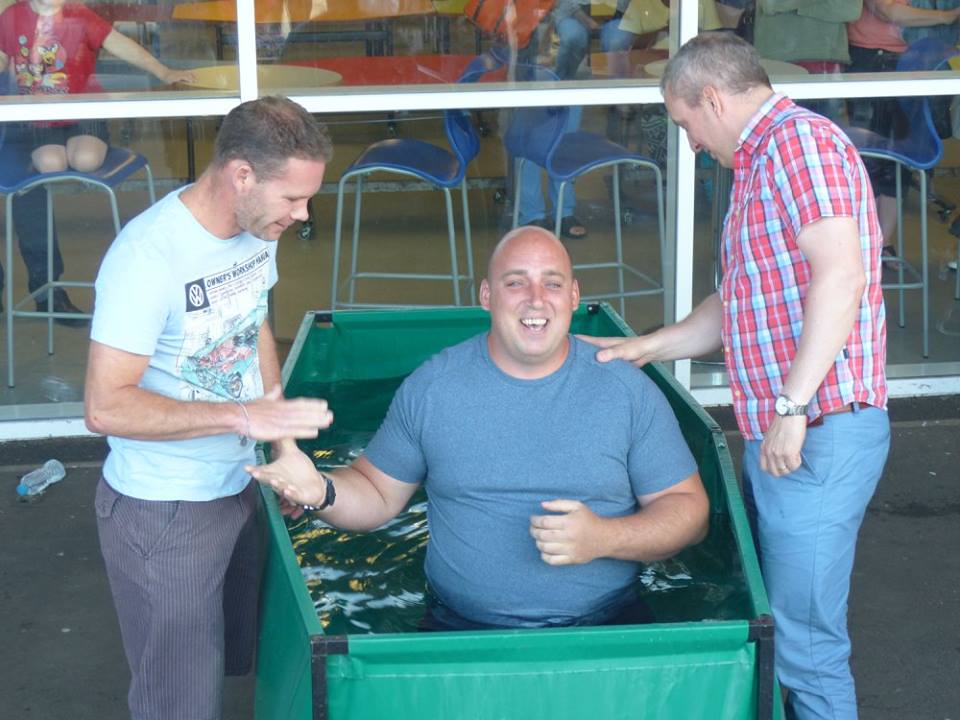
After trying the other options, we built our own. We contacted a local tarpaulin company who made us a custom tarp to size. They thought we wanted a tarpaulin coffin — which gave us a great opportunity to explain the theology of baptism and share the gospel.
Our dimensions: 210cm × 75cm wide × 75cm high. That fits most adults comfortably. The challenge is building a frame strong enough to hold nearly two tonnes of water without bowing outward.
- Mark 1 — steel square tube with plastic fittings. Works but is fiddly and bows in the middle
- Mark 2 — structural timber (3×2s). Stronger, easier to pack, our current setup
- 2021 modification — reduced the height for seated baptisms, which dramatically cut fill time
The IBC tank system — our fast-fill solution

A friend who runs a hot tub business suggested using an IBC tank — a pallet-sized 1,000-litre container used in food production. We got one from a local food producer for £25. Cut a hole in the top for a submersible pump and heater, fill it in the van the night before, run the heater overnight, and arrive on Sunday with warm water ready to pump into the baptistry in about 30 minutes.
If you buy an IBC tank for van transport, look for one with internal baffles — it stops the water sloshing and the van rocking as you drive.
This submersible pump will fill our baptistry in about 30 minutes:
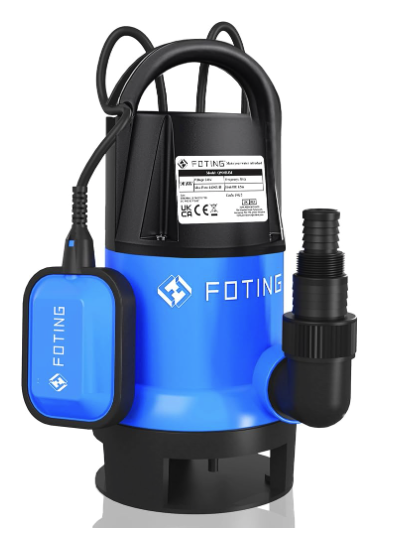
Best for: churches that baptise regularly, have a van, and want the most flexible long-term setup.
Option 5 — Professional portable baptistries
Several companies make purpose-built portable baptistries. They look polished, are designed for the job, and come with proper drainage and covers — but the cost reflects that.
- Portable Baptistry UK — around £1,000
- Baptistry UK — around £2,000
Best for: larger churches that baptise frequently, want a professional appearance, and have the budget for a long-term investment.
Heating the water

Cold tap water in the UK is around 10–15°C — bracingly cold for baptism. A submersible 2–3kW immersion heater left running overnight will raise the temperature to a comfortable level and plugs into a standard socket.
Lag your tank with polystyrene sheeting to retain heat — it makes a significant difference, especially overnight.
⚠️ Safety first — you need an RCD
Always use an RCD (residual current device) plug with any electrical equipment near water. An RCD cuts the power instantly if a fault is detected and could save a life. Always unplug the heater completely before anyone enters the water. Electricity and water are a fatal combination — there has been a baptistry fatality in the USA involving an unguarded heater.
Where else to baptise
Before settling on a portable baptistry, we tried a couple of other locations worth knowing about:
- The sea — memorable, but restricted to summer and the right tide conditions. Not everyone can attend.
- A local swimming pool — works well but usually can’t happen during a Sunday meeting, which means some of the congregation miss it.
Both are worth considering for special occasions, but a portable baptistry gives you much more control over timing and congregation involvement.
Summary — which should you choose?
- Tightest budget, happy to set up the evening before → Easyset inflatable pool*
- Occasional baptisms, want a hire option → Birth Pool in a Box
- Regular baptisms, want something durable → Urban Ice Tribe stock tank*
- Regular baptisms, have a van, want full control → DIY tarpaulin baptistry with IBC tank
- Larger church, budget available, want professional quality → purpose-built portable baptistry
* As Amazon and Urban Ice Tribe affiliates we earn a small commission on qualifying purchases at no extra cost to you.